Children of the Corn
Children of the CornThe Children of the Corn are the children of Gatlin who organize their lives around He Who Walks Behind the Rows, a corn-centered deity whose demands are treated as law. Their faith gives the children a shared explanation for violence and a strict age-based order: they sacrifice those who reach the prescribed limit, then lower that limit after a crisis. By the end, the same belief that governs the community leads its older members into the corn, while younger children remain to interpret and continue its practices.
Origins and Doctrine
The group’s history emerges through Burt Robeson’s reconstruction of the events of 1964. He finds that Richard Deigan took the name Amos, and that Amos and his friends acquired religion before killing Gatlin’s adults. Burt suspects the children believed the corn was dying because people had sinned and that more sacrifice could restore it. His account links the children’s takeover to a transformation of ordinary agricultural dependence into religious obligation: the crop’s condition becomes evidence of divine favor or displeasure, and killing becomes a remedy understood as sacred duty.
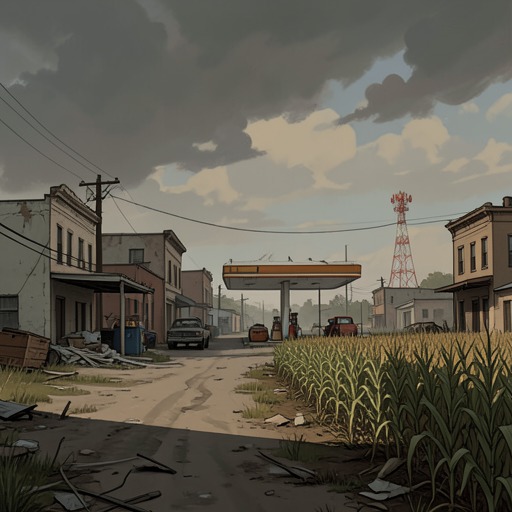
The doctrine has a local vocabulary and a local authority. At a radio station near Gatlin, a preacher speaks of atonement and warns listeners against becoming “smirched by the world”; the station’s red tripod tower stands above the corn. The church sermon board, meanwhile, announces “THE POWER AND GRACE OF HE WHO WALKS BEHIND THE ROWS.” Its date, July 24, 1976, shows that the name and worship remain publicly established years after the takeover. Burt recognizes the phrase as a name for God specific to Nebraska, but the children’s faith is not merely a renamed conventional religion: its divine presence is attached to the corn and to the community’s sacrificial order.
The objects and texts associated with the faith make that order tangible. Vicky finds a small crucifix fashioned from dried corn husk and cornsilk, with most kernels removed from a cob so that the remaining kernels form a figure of Christ, complete with the letters INRI. Burt also discovers a book bearing the injunction, “THUS LET THE INIQUITOUS BE CUT DOWN SO THAT THE GROUND MAY BE FERTILE AGAIN SAITH THE LORD GOD OF HOSTS.” Its child-drawn lettering and carefully erased marks make the record feel like a doctrine produced and maintained within the children’s world. In the weeks after the final crisis, the girls make more corncob crucifixes, using them as protection against further evil.
Collective Power and the Attack
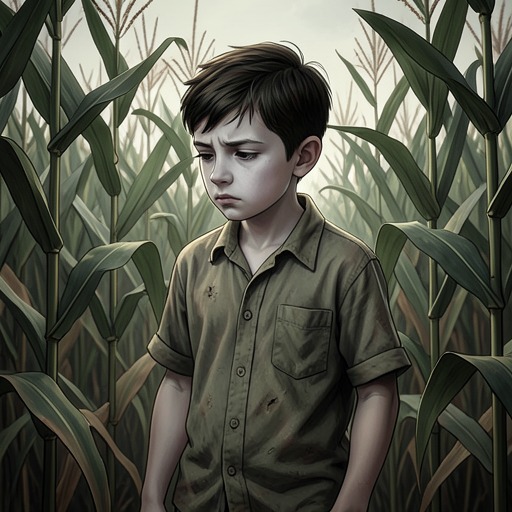
The children’s rule is revealed not only through their beliefs but through their coordinated action. When Vicky sounds the car horn outside the church, children arrive from side streets, the town green, and the school playground. Their clothing distinguishes them as a community: the girls wear long brown wool and faded sunbonnets, while the boys wear black and round-crowned, flat-brimmed hats. They cross the square toward the car with the composure of a group acting under shared authority, smiling and pointing as they approach.
They carry knives, hatchets, pipes, rocks, hammers, and a jackhandle; the evidence notes that none carries a gun. The children attack the Thunderbird together, damaging it until Vicky can no longer use it to summon help. Their effort to reach her inside the car makes clear that their religious order is also a coercive political power: outsiders are not simply unwelcome but subject to capture and sacrifice. Burt’s intervention breaks the expected pattern when he kills one of the attackers. The red-haired boy has warned him that he will soon stand before God’s throne, framing the assault in the group’s religious language; Burt’s resistance is, in turn, an action the children’s established story does not appear to anticipate.
Sacrifice and the Age of Favor
The community’s central rule is the Age of Favor: those who reach nineteen plantings and harvestings must enter the corn as sacrifices. Burt identifies the rule through the child-written record and connects it to the deaths of adults and older children in 1964. His account suggests that Amos Deigan, born September 4, 1945, was himself sacrificed on his nineteenth birthday in 1964. Burt also recognizes the rule’s continuing reach in the dates of Rachel Stigman’s and Moses Richardson’s birthdays, which make their approaching nineteenth year a threat rather than a milestone.
The rule does not remain fixed. After the final events, the children gather in the clearing before two crucified skeletons and two bodies that will eventually become skeletons. Isaac, only nine, speaks as the community’s Seer, a role he has held since the corn took David a year earlier. In a dream, Isaac says, the Lord appeared as a shadow walking behind the rows and declared displeasure with the sacrifice. He reports that the deity has completed the sacrifice itself, comparing the event to the Blue Man and the false minister who escaped years before. The children respond with dread, treating Isaac’s dream as authoritative revelation.
Isaac announces that the Age of Favor has been lowered from nineteen plantings and harvestings to eighteen. The change makes the doctrine newly immediate: Malachi and Joseph, the two eighteen-year-olds among those present, become subject to the rule, as do others still in town. The community’s response shows how religious authority and collective pressure reinforce one another. The children turn to Malachi, who had led the hunt for Japheth, now called Ahaz, and had killed him and cast his body outside the corn to prevent its polluting or blighting the crop. Malachi answers that he obeys God. The corn seems to approve, and the group accepts the lowered age limit.
The Community’s Ending
That night, all those already above the new Age of Favor walk silently into the corn and go to the clearing to seek continued favor from He Who Walks Behind the Rows. Malachi leaves without turning back. Ruth, pregnant with his child, says goodbye and watches him enter the corn; she remains behind, grieving and afraid. Her private hatred of the corn, and her occasional dream of setting it alight when the stalks are dry, reveal a division between the community’s obedience and her own fear. Yet she also believes that something in the corn watches, even the secrets held in human hearts.
The ending gives the children’s religious system a double result. Its age rule once organized sacrifice as a recurring duty; lowered to eighteen, it sends the older members of the surviving group to the same fate. The children had built a community in which divine favor, agricultural survival, and violence were bound together, but the final departure empties that community of those newly subject to its law. As dusk becomes night, the corn rustles around Gatlin and is described as well pleased. The belief system survives in the younger children’s interpretation and ritual, while its human cost is carried by the bodies and absences it leaves behind.